

Artificial Intelligence (AI) is a technology that lets machines do things we usually think only humans can do, like recognizing speech, making decisions, or solving problems. It’s changing the way we live and work, mostly by helping computers learn from data and get better over time—no constant hand-holding required.
This gives computers a serious speed and accuracy boost for all sorts of complex tasks.
AI pops up everywhere—from the systems recommending your next binge-watch to those virtual assistants that actually (sometimes) understand what you’re saying. Under the hood, these systems lean on machine learning or deep learning to sift through information and spot patterns.
If you get how AI works, it’s easier to see why it’s taking over industries like healthcare, finance, and transportation.
The power of AI is in its knack for adapting and learning. Of course, that brings up some big questions about ethics and what the future of work will even look like.
Key Takeways
- AI lets machines handle tasks that need human-like smarts.
- It uses learning methods to improve and tackle tricky problems over time.
- AI’s rise brings both cool opportunities and some serious ethical questions.
Defining Artificial Intelligence

Artificial intelligence is all about building machines that can do things people usually do with their brains. That means learning from data, solving problems, and making decisions.
The field has roots in both theory and real-world inventions, and it’s evolved a lot over the years.
Understanding AI and Its Core Principles
Artificial intelligence is basically designing computer systems to act like they’re smart—learning from experience, recognizing patterns, and making decisions from data.
AI systems pull this off using things like machine learning and natural language processing.
There are two main flavors: narrow AI, which is laser-focused on specific jobs, and general AI, which would be able to do pretty much anything a human can. Most of what we have now is narrow AI—think speech recognition or those endless recommendation feeds.
Some big ideas behind AI include adaptability, problem-solving, and autonomy—so machines can get better and handle new stuff without being told exactly what to do.
Evolution and History of Artificial Intelligence
The concept of artificial intelligence isn’t exactly new—it’s been floating around since ancient times. But it became an official field in the 1950s, with the term “artificial intelligence” first popping up at a 1956 research conference.
Early AI was all about symbolic reasoning, but those systems couldn’t really handle anything too complicated.
AI’s history is a bit of a rollercoaster, with bursts of excitement and long “AI winters” when things stalled out. But as we got more data and better computers, machine learning and robotics took off.
Now, instead of just following rules, AI can actually learn and improve on its own.
Alan Turing and Foundational Theories
Alan Turing is kind of the OG of AI history. He came up with the idea of a universal machine—the Turing Machine—that could, in theory, simulate any computation.
That concept is basically the backbone of modern computers and AI.
Turing also dreamed up the “Turing Test,” a way to see if a machine can act so smart you can’t tell it’s not human. It’s still a big deal in AI research.
His work made it possible to even talk about intelligence as something machines could have or be tested for. If you’re curious about the roots of AI, check out what is artificial intelligence.
Types and Hierarchy of AI
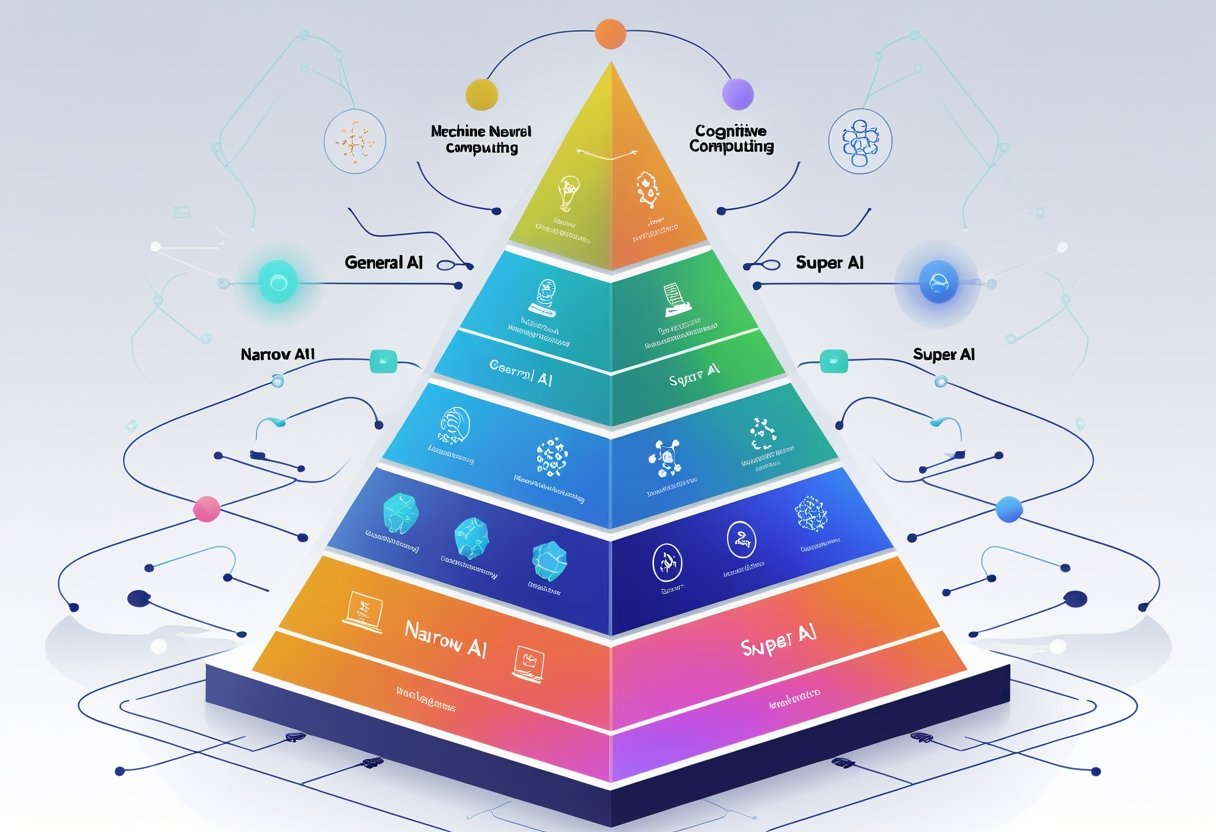
AI comes in a bunch of different types, depending on what it can do and how broad its skills are. Some systems are built for specific tasks, while others are (theoretically) aiming for human-level smarts or beyond.
These categories help us make sense of what AI can do now—and what it might pull off in the future.
Narrow AI (ANI)
Narrow AI, or Artificial Narrow Intelligence (ANI), is basically a specialist. It does one job, and that’s it.
Think virtual assistants like Siri, recommendation engines, or the navigation in self-driving cars.
ANI is really good at its one thing, but don’t expect it to do much else. It doesn’t know or care about anything outside its programming.
Most AI you see today—including language models like ChatGPT—fits in this box.
Its real strength is chewing through massive amounts of data and nailing those narrow, well-defined jobs.
Artificial General Intelligence (AGI)
Artificial General Intelligence (AGI) is the dream: an AI that can understand, learn, and tackle just about anything a person can.
AGI doesn’t exist yet, but plenty of researchers are chasing it. It’d be able to reason, solve problems, and adapt to new situations without needing a custom program for every new thing.
Getting there would mean big leaps in algorithms, processing power, and a deeper understanding of how humans actually think.
Artificial Superintelligence (ASI)
Artificial Superintelligence (ASI) is the next (maybe scary?) step—an AI that’s smarter than humans in every way. That means creativity, emotional smarts, problem-solving, the works.
ASI is still just a theory, but people love to speculate about what it could mean. It’d be able to improve itself and change society, science, and business at a breakneck pace.
Of course, we’re nowhere near this yet. It would take some wild breakthroughs for machines to not just learn, but actually innovate on their own.
Weak AI vs Strong AI
You’ll hear about Weak AI and Strong AI, which are really just ways to talk about how “aware” or “conscious” an AI is.
- Weak AI does specific tasks, runs on set algorithms, and isn’t conscious—most AI today is in this camp.
- Strong AI would have actual self-awareness, feelings, and the ability to understand things for itself. That’s more in the realm of AGI and beyond.
This split helps clarify all the debates about where AI is headed. Weak AI is here and useful, but strong AI is still just a topic for late-night arguments and ethics panels.
Want more on these categories? Take a look at the 7 types of AI explained or the Artificial Intelligence hierarchy.
How AI Works: Concepts and Components

AI works by chewing through tons of information, spotting patterns, and then using what it learns to solve problems. It all comes down to good data, clever models, and a whole lot of automation.
Training Data and Data Processing
Training data is where it all starts. These are examples—images, text, numbers—that help the AI figure out what’s what.
If the data’s messy or off-target, the AI won’t learn much. Data processing is about cleaning things up and getting it all into a format the AI can actually use.
You want to ditch the junk and keep only the good stuff. The quality and amount of training data make a huge difference in how well an AI works.
Voice assistants, for example, get better the more real-world speech they hear.
AI Models and Algorithms
AI models are like blueprints for thinking. They use algorithms—step-by-step instructions—to crunch data and make predictions.
There are all sorts of models out there. Supervised learning uses labeled data (where the answers are known), while unsupervised learning digs for hidden patterns in unlabeled data.
Reinforcement learning? That’s more trial and error, learning by getting rewards (or not).
Which algorithm you pick depends on the job. Neural networks are great for images and speech, while decision trees are handy for sorting stuff into categories.
Automation and Problem Solving
Automation is what lets AI handle repetitive or complex jobs without bugging a human every five minutes. Once it’s trained, an AI can chew through new data and spit out solutions in no time.
It breaks big problems into smaller chunks, weighs the options, and predicts what’ll happen—then picks the best move. This is gold in areas like medical diagnosis, fraud detection, or even playing chess.
With automation, jobs that would take a person hours can be done in seconds. That’s a game-changer for all kinds of industries.
You can dig deeper into the parts of AI at Key Components of Artificial Intelligence (AI).
Machine Learning: The Backbone of AI

Machine learning (ML) is what lets computers get smarter over time without someone rewriting the code every day. It’s all about finding patterns, making predictions, and getting better with experience.
Different methods are used depending on how the data is labeled and how feedback is given.
Overview of Machine Learning (ML)
Machine learning is a branch of AI focused on building systems that get better at their jobs just by practicing. Algorithms search for patterns in the data and use those insights to handle new situations.
The basics? You gather data, pick out the important bits, train a model, and then see how well it does. This process powers things like voice recognition, recommendation engines, and fraud detection.
Machine learning is split up by how it learns—supervised, unsupervised, and reinforcement learning. Each one is good for different types of problems.
Supervised Learning Techniques
Supervised learning is all about teaching a model with labeled data, where you know both the question and the answer. The idea is for the model to learn the connection so it can predict answers for new stuff.
Popular algorithms here include decision trees, support vector machines, and neural networks. You’ll see these in things like spam filters or predicting house prices.
The model tweaks itself to get closer to the right answer by comparing its guesses to the real thing. But it only works well if you’ve got good, clearly labeled data.
Unsupervised Learning Applications
Unsupervised learning is what you use when you don’t have labeled data. The AI just tries to find hidden patterns or groups inside the data, with no idea what the “right answer” is.
Clustering (like k-means) groups similar things together, while dimensionality reduction makes big piles of data more manageable.
It’s handy for customer segmentation, spotting strange activity in security, or organizing a mountain of documents. If labeling is too expensive or just not possible, this is the way to go.
Reinforcement Learning Explained
Reinforcement learning (RL) is a bit different. Here, an agent learns by doing—trying things out, getting rewards or penalties, and slowly figuring out the best moves.
The cycle goes like this: the agent acts, the environment reacts, and the agent updates its strategy. It’s all about maximizing long-term rewards.
RL is big in robotics, game playing, and self-driving systems. What makes it unique is that it learns from consequences, not just a fixed set of examples.
If you want the nitty-gritty on machine learning and how it fits into AI, IBM’s got a pretty solid machine learning guide.
Deep Learning and Neural Networks
Deep learning is where things get really interesting. It uses complex algorithms to help machines spot patterns in huge data sets—kind of like how our brains work.
Layers of artificial neurons process info, letting neural networks handle stuff like images, speech, or text.
Understanding Deep Learning (DL)
Deep learning is a chunk of machine learning that’s all about training neural networks. These models have multiple layers, so they can analyze raw data without humans having to spell out what to look for.
Each layer takes the data and turns it into something more abstract.
Unlike old-school machine learning, where people have to define the features, deep learning figures them out by itself. That’s why it’s so good with messy, unstructured data like images, sound, or language.
It’s not perfect, but deep learning is a big reason AI has gotten so impressive lately—especially for the really tough problems.
Artificial Neural Networks
Artificial neural networks, or ANNs, are inspired by how our brains work. They’re made up of nodes (neurons) stacked into layers: you’ve got your input layer, then one or more hidden layers, and finally, the output layer.
Each connection between neurons has a weight, which changes as the network learns. During training, these weights get adjusted so the network’s predictions get closer to the real answers.
Layers crunch numbers to transform input data into something meaningful. Activation functions like ReLU or sigmoid make things less linear, which lets the network handle trickier problems.
ANNs are everywhere in AI—classification, regression, clustering—you name it. They’re really the backbone of deep learning models.
Applications of Neural Networks
Neural networks pop up in all sorts of places. For instance, in image recognition, they can pick out faces or spot a car in a photo.
Speech recognition? Neural nets are behind that too, turning your voice into text with surprising accuracy.
Recommendation engines on Netflix and YouTube? Yep, neural networks analyze what you like and suggest new stuff. Self-driving cars use them to make sense of their surroundings and decide what to do next.
They’re also central to natural language processing—think translation, sentiment analysis, or chatbots. Machines are getting better at understanding and generating language that actually sounds human.
If you want to dig in more, check out how deep learning models use artificial neural networks at Built In’s deep learning article.
Natural Language Processing and Large Language Models
Ever wonder how machines can make sense of what we say or write? That’s where AI’s language skills come in—helping computers read, analyze, and respond to us in ways that sometimes feel surprisingly natural.
Natural Language Processing (NLP) Basics
Natural Language Processing, or NLP for short, is a branch of AI focused on helping computers “get” human language. It relies on algorithms to break down text and speech, making things like translation, sentiment analysis, and information extraction possible.
NLP splits language into pieces—words, sentences, meanings. It wrestles with ambiguity and context, trying to figure out what we really mean. By chewing through tons of data, NLP finds patterns and relationships, so its responses get sharper over time.
It’s powering a lot of what we use today: search engines and voice assistants, to name a couple. Basically, it turns the way we talk into something machines can actually work with.
Large Language Models (LLMs)
Large Language Models are a big leap in AI’s ability to handle language. They’re trained on mountains of text and can spit out, understand, or even manipulate language at a level that sometimes makes you do a double take.
Think OpenAI’s GPT-3, GPT-3.5, GPT-4, or Google’s Gemini. These models have billions of parameters and generate text that can sound eerily human.
They’re used for writing, summarizing, answering questions—you name it. LLMs use generative AI to create content that mostly makes sense in context.
Sure, their “understanding” isn’t quite like ours, but they’re pretty good at mimicking conversation and writing.
Chatbots and Conversational AI
Chatbots are where NLP and LLMs meet real-world conversation. They take what you type (or say) and try to respond in a way that feels natural.
Modern bots like ChatGPT, built on GPT-4, can chat in detail, answer questions, and help with all sorts of tasks. They use generative AI to keep their replies relevant and, at times, surprisingly thoughtful.
Conversational AI isn’t just about talking—it’s about managing dialogue, too. It’s used everywhere: customer service, education, personal assistants. The quality really depends on how well the models handle context and uncertainty, which, let’s be honest, isn’t always perfect.
Curious for more? Try Natural Language Processing and Large Language Models Explained, or see what’s new at Applications of natural language processing and large language models.
Computer Vision and Image Recognition
Computer vision lets machines “see” by analyzing images and videos. Image recognition goes a step further, breaking down what’s in the picture—objects, patterns, even faces.
Technologies like facial recognition depend on these skills, but things like deepfakes have made the landscape a bit more complicated.
Image Classification and Recognition
Image classification is about sorting images into categories, based on what’s in them. Machines look at pixels and figure out if it’s a cat, a car, or a skyscraper.
Deep learning models—especially Convolutional Neural Networks (CNNs)—are the go-to here. They learn to spot features like edges, shapes, and textures.
Image recognition takes it further. It doesn’t just label the image, but actually finds and locates specific objects inside it. Techniques like object detection draw boxes around what matters.
Popular methods? YOLO (You Only Look Once) and R-CNN, which try to balance speed and accuracy.
Key terms:
- Image classification: Labeling the whole image
- Object detection: Spotting and tagging multiple things in an image
- Convolutional Neural Networks (CNNs): Special AI models for image stuff
These tools show up everywhere—from medical imaging to self-driving cars. Want more? Here’s a Computer Vision guide from GeeksforGeeks.
Facial Recognition Technologies
Facial recognition figures out who someone is by analyzing their facial features. It looks for landmarks—eyes, nose, mouth—and picks out patterns unique to each face.
It’s used for unlocking phones, security systems, and even by law enforcement. Algorithms like Eigenfaces and deep learning methods help it work even with weird angles or bad lighting.
But it’s not perfect. Accuracy can dip with different populations, and privacy is a big concern. There’s ongoing work to cut down on bias and stop spoofing—like tricking systems with photos or videos.
Facial recognition brings together computer vision and AI, and it’s become a key player in a bunch of industries.
Deepfakes and Related Challenges
Deepfakes use AI to create fake but realistic images or videos—usually by swapping faces or tweaking expressions. They’re powered by generative models like GANs (Generative Adversarial Networks), which learn to make visuals that fool even sharp eyes.
It’s impressive tech, but also risky. Deepfakes can spread misinformation, sway opinions, or even ruin reputations.
Spotting deepfakes is tough. It means looking for oddities in movement, lighting, or even tiny pixel details. Researchers are hustling to build detection tools that can flag this stuff before it causes trouble.
If you’re working with visual data, knowing about deepfakes isn’t optional anymore. They show both the power and the pitfalls of AI in computer vision.
AI in Speech and Voice Technology
AI’s made huge strides in how machines handle speech. Now, devices can turn spoken words into text and talk back in voices that sound almost real.
This tech is everywhere—making it easier to talk to machines and get things done hands-free.
Speech Recognition Systems
Speech recognition uses AI to turn what you say into written words. Deep learning models listen to audio, break it into phonetic sounds, and then piece it together as text.
These systems get better by learning from lots of voices, accents, and background noise.
How do you know if it’s any good? The word error rate (WER) tells you—lower is better. Modern systems can transcribe quickly and accurately, even with distractions.
You’ll see speech recognition in live captions, call center transcripts, or voice commands. Businesses use it to analyze conversations and improve customer service.
Popular assistants like Alexa and Google Assistant rely on speech recognition for snappy, accurate understanding.
Voice Assistants and Smart Speakers
Voice assistants—Alexa, Google Assistant, you know the ones—use AI to chat with you naturally. They mix speech recognition with text-to-speech to make the whole thing feel seamless.
They’ll control your smart home, set reminders, play music, or answer trivia. AI keeps getting better at handling different accents, slang, and the weird ways we phrase things.
Smart speakers with these assistants let you go hands-free. They’re convenient, accessible, and support multiple languages. Businesses are jumping in, too, using voice tech to automate support and boost engagement.
Voice assistants rely on huge datasets and clever algorithms to juggle complex conversations and respond fast. They’re a staple of modern tech life.
If you’re curious about the nuts and bolts, here’s a solid AI voice calls explainer.
Real-World Applications and Industry Use Cases
AI is everywhere these days, shaking up how work gets done. It’s making things safer, more efficient, and sometimes just plain easier by crunching data and automating the boring stuff.
Autonomous and Self-Driving Cars
Self-driving cars lean on AI to read the road, spot obstacles, and figure out traffic. Sensors and cameras feed real-time data, so the car can make driving decisions without a human at the wheel.
Companies like Tesla and Waymo are pushing this tech to cut down on accidents and human error. Machine learning helps with navigation and dodging obstacles, while AI systems keep getting smarter with every mile.
It’s not just cars—autonomous trucks and delivery bots use AI to streamline logistics. Still, there are hurdles: weather, messy traffic, and a patchwork of laws. Progress is steady, though.
Healthcare and Fraud Detection
In healthcare, AI speeds up diagnosis by scanning medical images, test results, and patient records. It can spot diseases early and suggest treatments, which is a big deal for outcomes and costs.
AI’s also fighting fraud in insurance and medical billing. It looks for weird claims or patterns, saving money and hassle for everyone involved.
Automated tools mean more accuracy and faster decisions, letting doctors and nurses focus on what matters—patient care.
Marketing, Sales, and Service Automation
AI is a game-changer in marketing. It personalizes content based on what customers actually do, not just what they say. Tools dig into behavior to suggest products or deals, driving engagement and sales.
In sales, AI sorts and scores leads so teams can zero in on the best prospects. It also nudges reps with next steps or pricing tips, thanks to predictive analytics.
Customer service gets a boost from chatbots and virtual assistants—they handle routine questions around the clock. Sentiment analysis tracks feedback on websites and social, so companies can tweak strategies on the fly.
AI Tools and Everyday Solutions
Generative AI tools like Midjourney let you create images or content without being a tech whiz. Coding assistants (hello, Microsoft Copilot) help programmers write better code, faster.
AI platforms can knock out back-office work—scheduling, invoices, data entry. No-code AI tools mean even small businesses can digitize without hiring a developer.
All this frees up people to focus on creative or strategic work, not just repetitive tasks. AI isn’t just for big companies anymore. For more examples, check out real-world business uses of AI.
Ethical Considerations, Challenges, and Future Trends
AI brings a whole set of tough questions—fairness, privacy, security, and more. There are technical headaches and legal gray areas, too. Meanwhile, new tech like quantum computing is on the horizon, and people are scrambling to keep up.
AI Ethics and Responsible Use
AI ethics is about building and using AI in ways that are fair and safe. It means having clear guidelines for how AI makes decisions and making sure it respects basic rights.
Responsible use? That’s about avoiding harm, keeping data private, and making someone accountable when things go wrong.
Organizations have to teach users and developers about risks. Transparency matters, so people know what AI’s doing. Laws are lagging behind, which leaves some gaps.
Ethics also means dealing with job loss honestly. Training can help workers shift roles, but it takes real effort. Building trust takes more than a press release.
Bias, Transparency, and Security
AI can pick up biases from the data it’s trained on. That can lead to unfair results, especially in hiring, lending, or law enforcement.
Fixing bias takes careful testing and regular audits. Transparency helps, too—if people can’t see how AI made a decision, trust goes out the window.
Security is a worry. AI handles a lot of sensitive info, so keeping it safe from hackers is a must. Attacks on AI could cause real harm or manipulation.
Managing these risks isn’t easy. It takes both technical fixes and ethical oversight.
Emerging AI Trends and Quantum Computing
AI’s not slowing down. We’re seeing bigger language models, smarter automation, and deeper integration in health and finance.
Quantum computing could be a game-changer. It uses quantum bits to crunch numbers way faster than regular computers, which could supercharge AI.
But let’s be real—quantum AI is still experimental. There are big questions about hardware and security.
If you’re planning ahead, keep an eye on these trends and invest in research. The future of AI might look a lot different than today.
Learning Resources and AI Courses
Education plays a huge role in understanding and working with AI. There are loads of online courses out there, ranging from beginner to advanced.
Platforms like Coursera, edX, and Udacity come to mind—they’ve got classes on AI basics, machine learning, and even ethics. Some universities and big-name companies are jumping in too, offering certificates and degrees focused on AI skills.
You’ll find courses covering data science, algorithms, and responsible AI practices. It’s a lot to take in, but these programs really do help folks get ready for careers and keep up with what the industry wants.
Honestly, with how fast AI keeps evolving, it feels like you’ve got to keep learning just to stay afloat.
Frequently Asked Questions
Artificial Intelligence leans on a few core elements: data, algorithms, and a good chunk of computing power. You’ll see it everywhere these days—from healthcare to finance to transportation—helping improve efficiency and decision-making.
What are the key components of Artificial Intelligence?
At its core, AI has machine learning, letting systems learn from data. Then there’s neural networks, which kind of mimic the brain’s structure.
Natural language processing is a big one too, helping machines understand and generate human language. Of course, none of this works well without strong data quality and plenty of processing power.
These pieces let AI recognize patterns, make predictions, and—hopefully—get better over time.
How is Artificial Intelligence applied in real-world scenarios?
AI’s behind voice assistants, fraud detection in banking, and those eerily accurate recommendation systems on streaming platforms. It even helps optimize supply chains and backs up medical diagnostics by crunching massive piles of health data.
In manufacturing, you’ll find AI robots handling repetitive tasks. That’s a big win for productivity—and, honestly, safety too.
What is the significance of the 30% rule in AI?
So, the 30% rule? It’s the idea that companies putting at least 30% of their resources into AI-driven automation and digital transformation see real jumps in efficiency.
It’s kind of a benchmark—enough investment to get results, but not so much that you’re overdoing it.
Could you explain the basic concepts underpinning Artificial Intelligence?
AI, at its heart, is about machines doing things we’d usually need people for. That means learning from experience (machine learning), understanding language (natural language processing), and tackling problems.
Algorithms chew through data, spot patterns, and make decisions. With more feedback and data, AI systems tend to improve—sometimes surprisingly fast.
What are the ethical considerations in the development of AI technology?
Ethics in AI is tricky. There’s bias—sometimes systems pick up unfair stereotypes from their training data.
Privacy is another headache, since AI often gobbles up huge amounts of user data. And don’t forget the risk of job losses or the need for transparency; people want to know how AI makes choices if we’re going to trust it.
How do the ‘7 C’s of Artificial Intelligence’ frame our understanding of the field?
The ‘7 C’s’—Connection, Cognition, Communication, Creativity, Compliance, Courage, and Compassion—shape how we think about AI. Each one highlights a different capability, from linking massive data sources to dreaming up creative solutions.
If you’re curious, these ideas sort of nudge AI to act more like us: more ethical, more thoughtful, maybe even more helpful when it comes to tricky problems.
For more detailed insights on common AI questions, see the Top 20 Questions About Artificial Intelligence.